
Intuify includes two tools designed to speed up survey creation: the AI Assistant, which can generate and improve surveys from plain-language instructions, and the Library, which lets you save and reuse surveys, questions, and templates.
AI Assistant#
The AI Assistant has its own dedicated page, accessible from the sidebar. It can also be used directly inside the Survey Builder.
Creating a survey with AI#
- Go to AI Assistant from the sidebar, or click AI Create on the Surveys page.
- You'll see a two-panel layout:
- Left side — A chat area where you type instructions, plus template cards and quick actions.
- Right side — A live preview of the survey the AI is building for you.
- Choose a template card to get started quickly (for example, Customer Satisfaction, Product Feedback, NPS Check-in, or Employee Engagement), or type your own instructions in the chat.
- The AI will generate a complete survey with sections, questions, and logic. You can see it take shape in the preview panel.
- Refine the survey by sending follow-up messages — for example:
- "Add follow-up questions for low NPS scores."
- "Simplify the wording and make it shorter."
- "Add a demographics section at the beginning."
- When you're happy with the result, click Create Survey to save it and open it in the full Survey Builder for any final tweaks.
Quick actions#
The AI page offers quick-action buttons for common tasks:
- Add a new section or block.
- Add specific question types (NPS, rating, choice, free text).
- Improve or shorten existing questions.
- Adjust flow or logic.
These send targeted instructions to the AI so you don't have to type everything out.
Starting over#
If you want a fresh start, use the Reset button to clear the conversation and preview.
Building a survey from a Word questionnaire#
If the questionnaire is already written in Word, AI can program the whole survey from the document: sections, questions, answer options, skip and display logic, terminates, randomization, carry forward, loops and the Custom Interfaces the document names.
-
On the Surveys page, click Create New Survey and choose Build from a Word questionnaire ("AI programs it from your .docx"). Inside HM Admin the same option sits next to Start from scratch and Build with AI on the Create New Survey page.
-
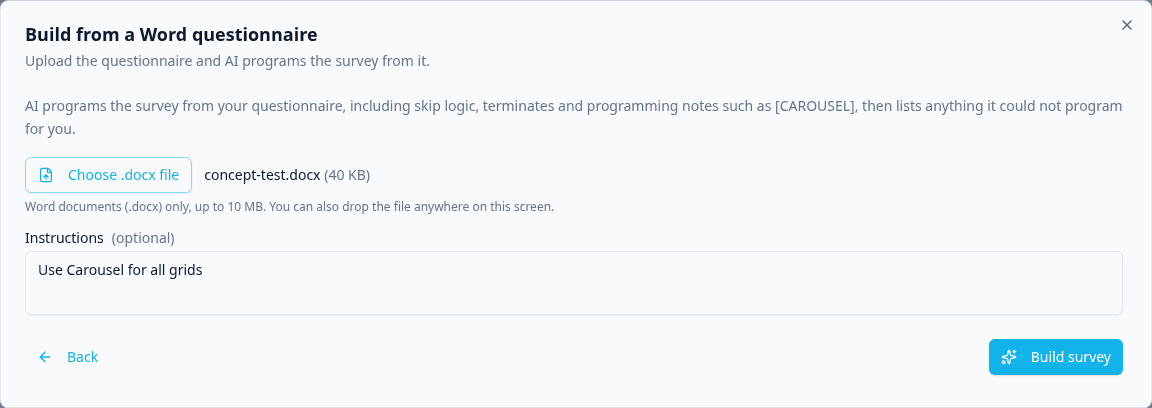
Click Choose .docx file and pick the questionnaire. You can also drag the file from your computer and drop it anywhere on the create screen.
-
Optionally add Instructions for anything the document does not say, for example "Use Carousel for all grids". Where they conflict with the document, your instructions win.
-
Click Build survey. The build runs in the background on our servers, so you do not have to wait on this screen: you can open other pages, reload, close the tab or move around HM Admin, and it keeps going. A long questionnaire can take a few minutes, plus a little longer for the check described below.
-
While it works, the panel shows plain steps such as Reading your document, Programming questions (with how many are built so far, for example 43 of 76), Adding logic, loops and flow, Checking the survey against your document and Saving your survey.
-
When the build finishes, the survey is created for you automatically. You see Survey ready with a summary of what was built and a Needs manual programming list of anything the AI could not program. Click Open survey to open it in the builder.
A Guided Story (voice) question in the document is built with the document's own words: its question text, its numbered list of spoken questions, its instruction lines and its voice settings. If the document gives a Guided Story no spoken questions, the question asks its own text and is listed under Needs manual programming so you can check it. The check against your document also flags a Guided Story that still shows the example text (for example the questions about denim jeans).
An Instruction Swiper in the document is built with its own screens: the numbered list under Screens:, each with its picture when the document has one on or directly under the screen (the picture is uploaded to your image library first, like every imported picture). A survey exported to Word prints its swiper screens this way, so they come back when you import the file. If the document gives a swiper no screens, its paragraph becomes the one screen and it is listed under Needs manual programming. The check against your document flags a swiper that still shows the example screens (for example "This is the first instruction slide").
Following the build from any page#
While a build is running, a tab sits on the right edge of every Survey Builder page, just above the Help tab. It follows the Help tab when you move that. Click it to open the same progress panel. The tab changes as the build goes on:
| The tab says | What it means |
|---|---|
| Reading | The AI is reading your document. |
| Building | The AI is programming the questions. A count such as 43/76 shows questions built against the questions found in the document; when follow-up questions take the count past that number, only the count is shown. |
| Adding logic | The AI is adding skip and display logic, terminates, loops and flow. |
| Checking | The AI is comparing the survey with your document. |
| Fixing | The AI is fixing the differences the check found. The panel shows how many, and which round of fixes it is on. |
| Saving | The build is done and the survey is being created. |
| Survey ready | The survey was created. Open the panel and click Open survey, or Dismiss to hide the tab. |
| Needs attention | The build finished but the survey was not created. The panel lists why (for example a question the AI left without answer options); fix the document and Try again. |
| Build failed | The build stopped, for example because the service restarted. Try again takes you back to the Word option to start it again. |
When the build finishes you also get a notification in HM Admin ("Your survey from concept-test.docx is ready for review", or "We could not build a survey from concept-test.docx" if it failed), so you can leave Survey Builder altogether while it runs. The survey is created once, even if Survey Builder is open in several tabs. A finished build stays on the tab for a day unless you dismiss it.
You can run one build at a time. Dropping another document on the create screen while a build is running is refused with a message, so the running build is never replaced by accident; closing the create dialog does not stop it. On the Create New Survey page, a document dropped while you are in Build with AI is not taken, so your AI conversation is kept; choose Build from a Word questionnaire first. If the document is refused before the build starts (for example it has no text), the reason is shown above the buttons and nothing runs.
What to upload#
- A Word document (.docx) up to 10 MB. Older .doc files, PDFs and other formats are not accepted; save the file as .docx first. Dropping anything else shows "Only Word documents (.docx) are supported".
- The questionnaire as you would hand it to a survey programmer: section headings, numbered questions (S1, Q10a and so on), answer options and grid rows and columns. Question numbers become the question tags in the builder, so logic that refers to "Q3" lands on the right question.
- A line starting Title: becomes the survey's name.
Pictures in the document#
Pictures placed in the text of the document are imported too. A picture on an answer option's line, or on its own line straight under an option, goes on that option (the same for grid rows and columns and ranking items). A picture in a question's text, or on its own line under the question text or just before its number, goes in the question's text; on an instruction screen it goes in the screen's text. Every picture is uploaded to your image library first, and the survey only ever uses that library copy. In a question's text it sits where you would put it with Insert image; on an answer option, row, column or item it is part of that entry's text. On a Custom Interface question an option's picture is set as the option's image instead, because that is where the interface shows it, and a picture in a Custom Interface or Guided Story question's own text is not placed (those screens cannot show it); it is listed under Needs manual programming (pictures). A picture used in several places is placed at each of them.
- PNG, JPEG and GIF pictures are imported, up to 40 per document, 5 MB each and 25 MB in total. The type is read from the picture itself, not from its name.
- Not imported yet: pictures inside tables, floating pictures (set to wrap text rather than "In line with text"), pictures in page headers and footers, EMF or WMF drawings, charts and shapes, and pictures linked from outside the document. Each one is listed in the summary under Needs manual programming (pictures) with the text it sat next to, so you can add it in the builder.
- A picture the AI did not attach to any question is listed there as well, and is already in your image library.
- A survey exported to Word with Images on comes back with its pictures. If a picture could not be embedded, the export prints an "(image: ...)" line instead; such a line is read back as the same picture only when the address is an image library link. Any other address is never used: it is listed under Needs manual programming (pictures). With Images off the export has no pictures, so none come back.
How programming notes are read#
Anything in [square brackets], text in ALL CAPS parentheses, and lines starting PROGRAMMER NOTE, PN:, BASE: or NOTE TO PROGRAMMER are treated as instructions, never shown to respondents. For example:
| Note in the document | What the AI programs |
|---|---|
| [SHOW IF Q3 = 1], [ASK IF ...] | Display logic on that question |
| [SKIP TO Q10] | Skip logic |
| [TERMINATE IF ...], "Under 18 [TERMINATE]", THANK AND CLOSE | A screen-out terminate |
| [RANDOMIZE], [ROTATE], "show 3 of 5" | Randomization of options, statements or sections |
| [CAROUSEL], [SWIPE], [TAP TO RANK], [FAST SELECT] | The matching Custom Interface |
| [SHOW ONLY THE BRANDS SELECTED AT Q3] | Carry forward from that question |
| [LOOP FOR EACH BRAND SELECTED AT Q7] | A section loop |
| (Exclusive), (Specify), "select up to 3" | Answer rules on that question |
Answer codes such as "1. Yes" are stripped to "Yes", and options stay in the document's order.
Checked against your document#
When the build finishes, the survey is checked against the document before you see it. The check does not rely on the AI's own account of what it built.
When the document is an Intuify Word export (edited or not), the check is complete and uses no AI: it turns the built survey into the same Word layout and compares the two line by line. Every line of the document has to be in the survey, in the same section and in the same place, and the survey may not add lines of its own. That covers the survey title and description, every section and its loop, every numbered question and every unnumbered instruction screen (matched by its text and its place, so a dropped "Thanks, let's carry on" screen is caught), question text, type and Custom Interface, Required, every answer option, row, column and item with its code and markers such as (Exclusive), answer rules, show if, skip, terminate, randomization, carry forward, Guided Story prompts and settings, Instruction Swiper screens, page breaks, translations, every flow step (groups, branches, randomizers, end of survey, variable assignments, set language, web service), quotas, global variables and panels.
For a document in any other layout, the check confirms that:
- every numbered question (S1, Q10a, P2 and so on) and every section heading exists in the survey,
- every question that names a Custom Interface uses it,
- every terminate, skip, show if, randomize, carry forward and loop note has a matching rule on that question or section,
- each question's type, answer options, rows, columns and items match what the document lists, with no placeholder items such as "Item 1" left behind,
- every picture in the document is on the question or answer option it sits with (this is part of the build only; Check against Word doc in the builder does not compare pictures).
Anything that does not match is handed back to the AI to fix, and the survey is checked again. The progress messages show this as Checking the survey against your document..., Found 9 things to fix. Fixing them (round 1 of 3)... and, once nothing is left, All checks passed. There are at most three rounds of fixes. The summary ends with a line saying how it went, for example "Checked against the document in 1 round of fixes: all checks passed." If the check itself cannot finish, for example because the build used most of its time, the summary says so and lists what a quicker check of the questions, sections and notes still found, instead of claiming everything passed.
The "Needs manual programming" list#
The summary opens with how many sections and questions were built, counted from the survey itself. When the AI finishes the whole document, the summary also has a Needs manual programming section. It lists, one line per question, every note the AI could not program, for example least fill on a loop, priority groups or detailed Custom Interface settings. Everything else about those questions is built; only the listed parts are left for you. A third part lists anything in the document the AI was unsure how to read and what it assumed.
If the check still finds differences after the fixes, the summary ends with a second list, Needs manual programming (still different from the document), one line per question with what is still missing. A difference lands there when no AI tool can build it at all (for example answer codes, export names, page breaks or translations; these are listed straight away and never cost a round of fixes), when the AI says it cannot program it with the tools it has, when a round of fixes did not fix it (it is not sent again), or when the rounds or the time for one build run out. Typical entries are notes the survey has no setting for, such as a screen-out on a grid nobody answered, or a "skip and auto-answer" rule.
If something in the built survey would stop it from being saved, for example a ranking question left with fewer than two items, the summary lists it under This survey cannot be saved until these are fixed, one line per question, and does not say the checks passed.
Read the lists before you click Create survey, and keep a copy, because the summary is not shown again once the survey opens in the builder.
A very long document, or an error partway through, can stop the build before the end. If there is time left, the check finds the questions that were not built and the fixes add them. Otherwise you see a message that says This survey is partial, with how many questions and sections were built, instead of the full summary and its lists. You can still create the survey; check it against the document and add what is missing. If a grid was waiting for rows carried in from an earlier question when the build stopped, it gets one placeholder row, "Add this grid's rows", and the message names the grid so you can fix it in the builder.
AI Edit inside the builder#
When you're already working in the Survey Builder, you can use AI without leaving the page.
How to use it#
- Click the AI Edit button (AI icon) in the builder's top toolbar and choose Ask AI to edit this survey.
- A side panel slides in from the right.
- You'll see a welcome message with quick actions and a text input for custom instructions.
- Click a quick action or type your own instruction.
- The AI reads your current survey, applies the changes, and updates the canvas.
- If you don't like the result, just hit Undo (Ctrl+Z) to revert.
The panel keeps your conversation history for the session, so you can build on previous instructions. You can close and reopen it at any time.
Quick actions#
| Action | What it does |
|---|---|
| Add Section | Adds a new section with 3 relevant questions based on your survey context |
| Add NPS | Adds an NPS (Net Promoter Score) question |
| Generate Flow | Analyzes your survey and generates a complete flow — screening branches, variable assignments, randomizers, and end-of-survey sections |
| Add Section Loop | Adds a Section Loop to the last section, repeating it for each option selected in the previous question |
| Improve Wording | Rewrites all questions to be more professional and unbiased |
| Reorder Logically | Reorders sections and questions in a logical flow, starting with easy questions |
| Trim Survey | Removes redundant or low-value questions while keeping key insights |
| Add Piped Text | Adds piped text tokens where they make sense, referencing previous answers to personalize the experience |
Custom instructions#
You can also type any free-form instruction. Examples:
- "Add a demographics section at the beginning"
- "Add a branch after section 1 to screen out unqualified respondents"
- "Add skip logic so irrelevant questions are hidden"
- "Track user segments with global variables"
- "Pipe the answer from Q1 into the next question's text"
- "Rewrite all questions at an 8th-grade reading level"
What AI Edit can modify#
AI Edit can update any part of your survey in a single instruction:
- Sections and questions — add, remove, reorder, rewrite
- Question configuration — answer options, validation, required flags
- Branch rules — route respondents to different sections based on answers
- Termination rules — end the survey early based on conditions
- Quota rules — set quotas for response limits
- Flow blocks — randomizers, set-variable blocks, end-of-survey blocks
- Global variables — create and assign variables for tracking
- Section loops — repeat sections based on prior answers
- Piped text — insert dynamic tokens into question text
Checking a survey against a Word document#
If the survey was programmed from a Word questionnaire, AI can read the document and list where the survey and the document disagree. It compares the survey as it is in the builder right now, including edits you have not saved yet. For a document that is an Intuify Word export, it compares every line of the document with the survey, as described in Checked against your document, and anything no AI tool can build is set apart as needing manual programming. For a document in any other layout, it looks at the questions, sections, question types, answer options, interfaces and the logic notes in the document; anything else in that document is not checked. The check never changes the survey; it only gives you a list to work through.
-
In the builder's top toolbar, click the AI Edit button and choose Check against Word doc…. You can also drag a .docx file from your computer and drop it anywhere on the builder page.

-
Pick the questionnaire (.docx only, up to 10 MB). A window titled with the file name, for example Check against "questionnaire.docx", opens straight away and fills in while the AI works.
-
The left side shows the document as the AI read it. The right side lists each gap it found. Every gap shows the question label and a short title, then three lines:
- Document: what the document says.
- Survey: what the survey has.
- Fix: a suggested change.
-
Each gap has these buttons:
- Show in document highlights the matching passage on the left and scrolls to it. When the same line appears under several questions, such as Randomize options, it highlights the one under the gap's own question.
- Go to question closes the window and selects that question in the builder. It is greyed out when the question is not in the survey, or was deleted after the check.
- Mark resolved moves the gap into the Resolved list at the bottom. Open that list and click Reopen to bring a gap back.
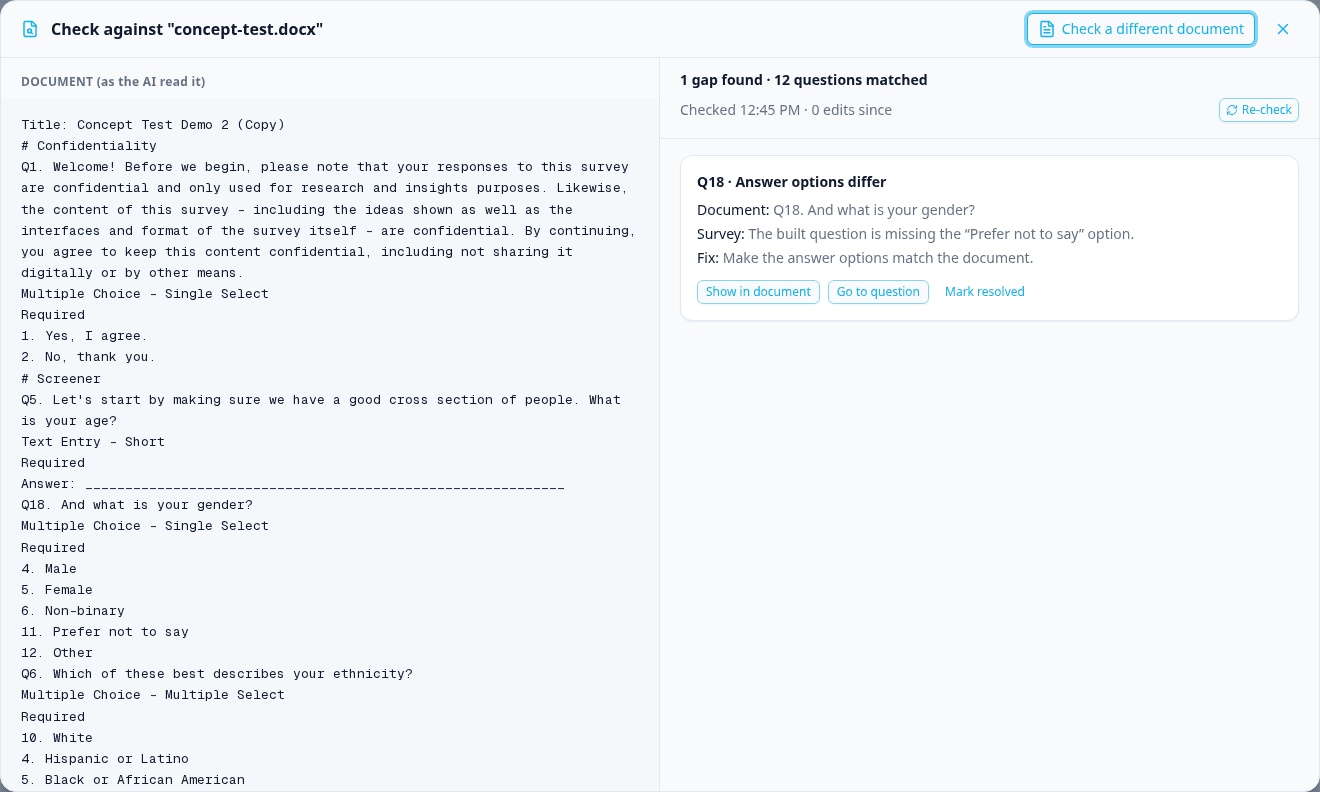
The top of the list shows how many gaps were found (only the ones you or the AI can fix) and how many questions were matched, when the check ran and how many edits you have made since. A gap whose question you have edited since the check is tagged Changed since check. Click Re-check to run the same document again against the current survey, or Check a different document to start over with another file. Starting a new check while one is kept asks Replace the current check? first, because it clears the current gaps and resolved marks. The file is checked before that question: a file that is not a .docx, or is over 10 MB, is refused and the current check stays. If the new check fails before it has read the document, the current check also stays and the reason is shown in a message. When nothing is found, the list says so and names what was compared.
Differences that no AI tool can build are not counted in that number. They sit below the gaps in a collapsed Needs manual programming (N) section: click it to expand the list. Each entry is the same card, with Show in document, Go to question and Mark resolved. Typical entries are flow branches that set variables, advanced randomization, per-option display logic, answer codes, quotas counted on a variable, an exclusive option on an interface that does not support one, or a Custom Interface this environment does not offer. When every difference is of this kind, the list says there are no gaps to fix. The badge on the AI Edit button also counts only the gaps that can be fixed.
You can close the window and keep editing. While a check is kept and has open gaps, the AI Edit button shows a badge with their number, and its menu offers Open document check to return to the list where you left off. The check is kept for the browser tab, so it survives closing the window and reloading the page, but not closing the tab.
Library#
The Library is where you save and organize reusable content — surveys, questions, and templates — so you don't have to start from scratch every time.
Survey library#
- Save any survey you've built as a library survey.
- Later, clone it to create a new project with the same structure and content.
- Manage your library surveys (rename, update, or remove them) from the Library page.
Question library#
- While building a survey, you can insert questions from the library using the question palette or a section's menu.
- This lets you drop pre-built questions or entire sections into your survey, complete with their original settings.
Templates#
Intuify provides ready-made survey templates for common use cases — CSAT, onboarding, product concept tests, and more. Many of these are also available as template cards on the AI Assistant page.
Templates give you a solid starting framework that you can customize to fit your specific needs.
How AI and Library work together#
- Surveys created or modified by AI are fully compatible with manual editing in the builder. There's nothing special about AI-generated content — it uses the same structure as hand-built surveys.
- Library items inserted into a survey bring along their logic, recode values, and styling, and can be further customized like any other question.
- From an analytics standpoint, there's no difference between AI-generated, library-sourced, or manually created questions. Everything flows into the same analytics and export pipelines.
Was this page helpful?