
Mode: configuration.maxDiffDesign = "tournament"
Demo survey: SV_WBp7VZbpnyoj4CnI · respondent link /s/gZblgzNo3bWZ
What it is#
A single‑elimination bracket (PPT slide 7). Items are split into groups; on each screen the respondent's Best pick wins its group and advances. Winners form the next round, and this repeats until one overall winner remains. It is adaptive — the next round depends on the respondent's actual picks — and the screen count is determined by the bracket, not a fixed number. Mutually exclusive with the Bandit.
Configuration used#
| Setting | Value |
|---|---|
| Design of Experiment | Tournament |
| Items per screen (group size) | 4 |
| Items | 8 |
| Screen count | dynamic (bracket‑determined) |
How it builds rounds#
Round 1 = a seeded shuffle partitioned into groups of 4. Each screen's Best advances (an odd leftover item gets a bye). The next round only appears once the current round is fully answered. Editing an earlier Best rewrites the affected downstream screens.
The round‑1 shuffle seed combines the question with the respondent's session id, so each respondent starts from a different bracket rather than everyone getting the same pairings. The seed is fixed for the duration of a session, so answering and back‑navigating never reshuffles a bracket mid‑flow.
Constraints in Tournament#
Tournament honours item‑pair constraints (QPM‑12897). Every round is built so that no constrained pair shares a screen — round 1, each later round built from the winners, and the final. If a round cannot be built without seating a constrained pair together (for example the final holds only two items and they are a constrained pair), that constraint is ignored for that round only; every other round still honours it. The Constraints card is shown for Tournament as for the other designs. The builder's "too tight" warning is not shown for Tournament, because Tournament never ships a short screen: it relaxes the constraint for that round instead. A Tournament with no constraints builds exactly the same bracket as before.
Live run — winners advance (8 → 2 → 1)#
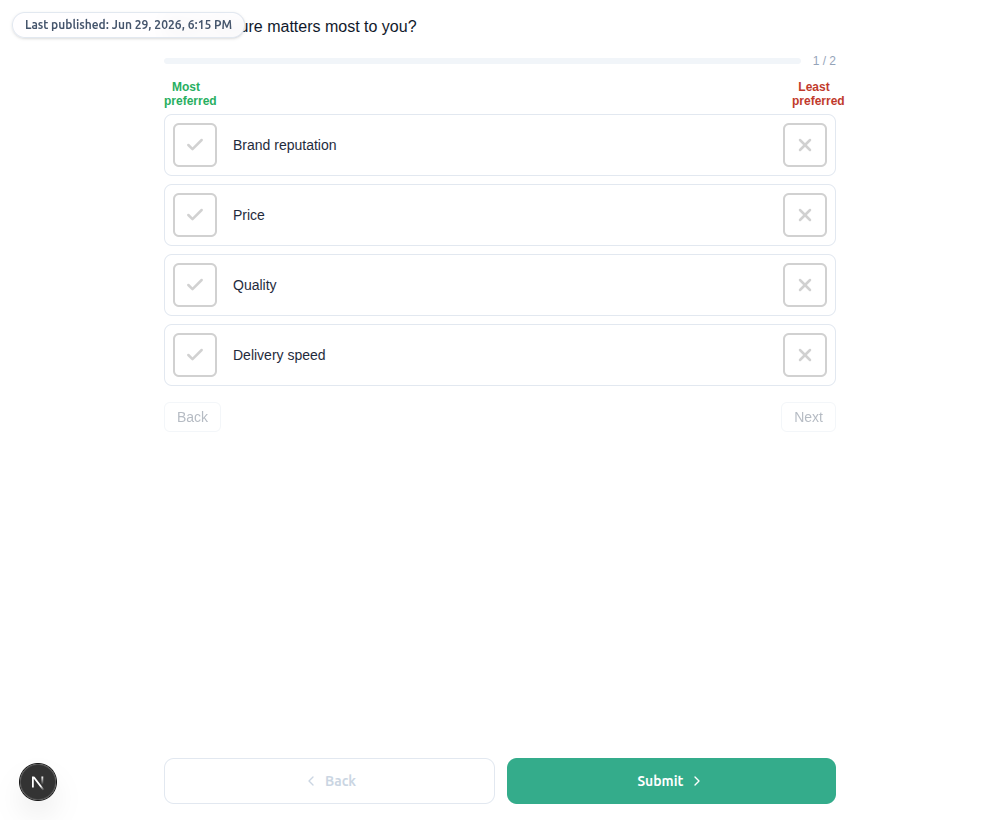
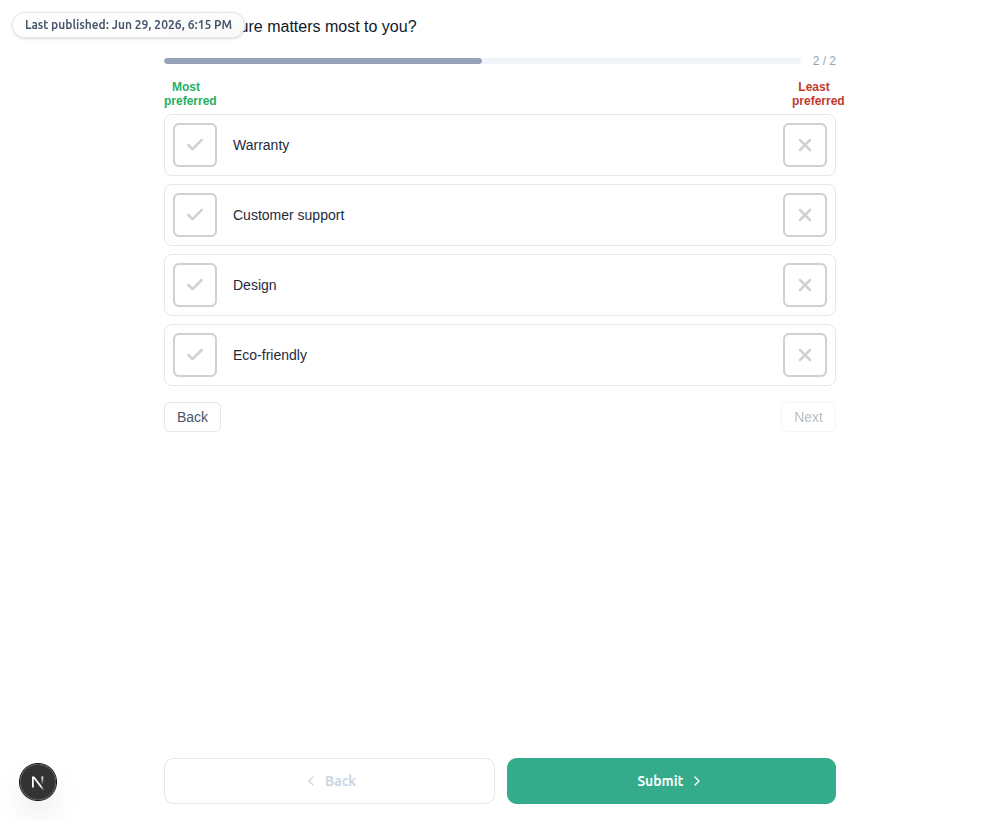
In this run the respondent picked the first‑listed item as Best each time.
Round 1 — two groups of 4#
| Screen | Items shown | Best → advances |
|---|---|---|
| 1 (1/2) | Brand reputation · Price · Quality · Delivery speed | Brand reputation |
| 2 (2/2) | Warranty · Customer support · Design · Eco‑friendly | Warranty |
Round 2 — the two winners meet (the final)#
| Screen | Items shown | Best → WINNER |
|---|---|---|
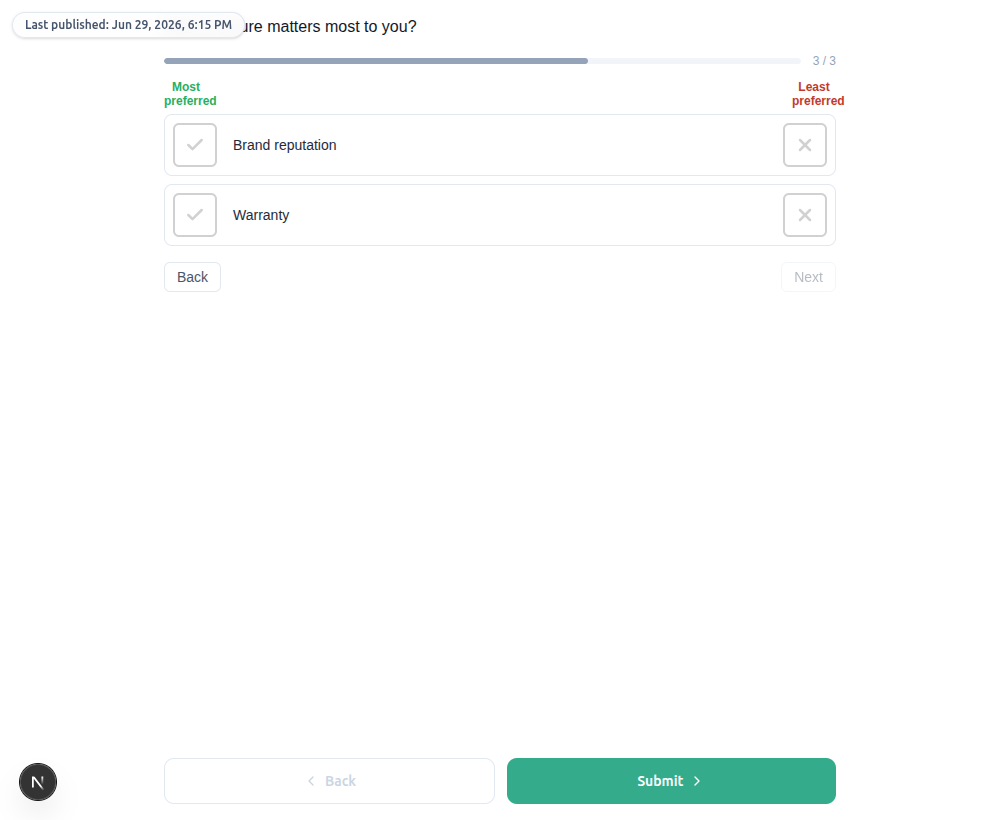
| 3 (3/3) | Brand reputation · Warranty | Brand reputation |
Result#
8 items
  ├─ Round 1 screen 1: {Brand, Price, Quality, Delivery} → Brand advances
  ├─ Round 1 screen 2: {Warranty, Support, Design, Eco}  → Warranty advances
  └─ Round 2 (final):  {Brand, Warranty}                 → BRAND REPUTATION wins
- The progress indicator grew 1/2 → 2/2 → 3/3 as round 2 was revealed after round 1 finished.
- Brand reputation genuinely advanced: it won its round‑1 group, appeared in the final, and won — confirming live winner‑advancement (not a static schedule).
- Total screens shown: 3 (2 in round 1 + 1 final), narrowing 8 candidates to 1 winner.
Was this page helpful?